Strategic Evolution Technical Assessment · August 2026

Millennium Group Inc. · Platform, Integration & Automation

Strategic Evolution
Technical Assessment Report

A technical assessment of where Millennium Group stands today across migration, licensing automation, and AI operations — acknowledging production-proven strengths and naming the highest-leverage evolution paths.

3 Technical Strategic Goals
5 Assessment Dimensions
3.4 Composite Readiness Score

Strategic Position & Capabilities

A balanced read on what Millennium Group has built in the field — and the production-proven strengths this assessment builds on.

Strategic Position

Exceptional infrastructure — ready for its next chapter.

65KEdge credentials
33AWS instances
60+Years in market
  1. Market standing

    Strongest technical foundations in access control — deployment, VMS, and platform advantages at scale.

  2. Edge resilience

    65K credentials on green boards — outage-proof access when cloud links fail.

  3. Hybrid deployment

    33 AWS instances + air-gapped on-prem — multi-tenant cloud and regulated isolated sites.

  4. API-first platform

    Swagger-documented APIs — every UI action callable; bulk upload in production.

  5. Commercial engine

    FOS licensing (~100 configs) — Sage billing live; EverSecure and Stripe underway.

  6. Intelligence & ecosystem

    AI & integrations shipping — doc chatbot, CCTV analytics, VMS pop-ups, vertical modules.

  7. Next chapter

    Wire automation to APIs, bridge FOS to payments, validate migration — show the market what's already built.
Capability Inventory

What's working well in the field today

Production-proven strengths — the foundation every growth initiative builds on.

  • Swagger-documented APIsEvery UI action maps to a provisioning endpoint
  • Green board controllers65K credentials · outage-proof access
  • Hybrid cloud + on-prem33 AWS instances · air-gapped option
  • Homegrown FOS engine~100 license configs · deep domain fit
  • Dealer network~5,000 integrators · 60+ years in market
  • AI in productionDoc chatbot · Amazon CCTV analytics
  • Live portals & CRMDealer portal · Salesforce pipeline
  • VMS integrationVideo pop-ups on door events
  • Vertical modulesMobile Connect · visitor · parking · CCTV

Three Technical Strategic Goals

Three platform evolution outcomes — each measured across five operational dimensions with a balanced view of strengths and targeted technical growth opportunities.

01

Accelerate Integration & Migration

Validate middleware intercept strategies and protocol translation to win competitive site takeovers without full hardware rip-and-replace.

Goal composite · 2.5 / 5
02

Modernize Business Systems & Licensing

Bridge FOS, Sage, and payment gateways into automated entitlement workflows — preserving the flexibility of your homegrown licensing engine.

Goal composite · 3.2 / 5
03

Scale AI & Automation Operations

Wire AI-assisted admin and external automation to your Swagger-documented provisioning APIs — moving beyond UI-driven operations at scale.

Goal composite · 3.2 / 5

Key Findings

3.4 out of 5
Technical composite

A production-proven platform — with clear technical evolution paths ahead.

Across three technical strategic goals and five operational dimensions, Millennium Group averages 3.4 / 5 — strong foundations in platform depth, commercial systems, and automation. The opportunity ahead is to extend that strength across migration intercept, licensing automation, and AI-assisted operations.

01

Platform depth is built — integration and automation are the multiplier

Hybrid deployment, 65K edge credentials, Swagger APIs, and the FOS licensing engine are live and field-proven. Wiring migration intercept, payment-to-license automation, and AI-assisted admin to those foundations unlocks the next chapter of technical evolution.

02

Migration intercept is architecturally credible — field proof is the next chapter

Middleware intercept and protocol-translation capability give Millennium Group a credible path to competitive site takeovers without rip-and-replace. Validated reference outcomes and automation maturity will turn this architectural advantage into repeatable win-back momentum.

03

The commercial engine is a crown-jewel asset — automation extends its reach

FOS, Sage, and the dealer portal form a proprietary entitlement backbone that off-the-shelf alternatives cannot replicate. Connecting payment confirmation directly to key-code generation is the highest-leverage step toward fully automated, self-service commercial workflows.

04

AI and automation are already in production — scale is within reach

Doc chatbot, CCTV analytics, and Swagger-documented provisioning APIs demonstrate real operational intelligence today. Wiring AI-assisted admin and external automation to those endpoints is the natural next step to move beyond UI-driven operations at enterprise scale.

Five Operational Dimensions

These five lenses define how every strategic goal is evaluated. Each goal receives a 1–5 score per dimension — reflecting readiness to deliver that outcome, not a standalone capability rating.

1 Early stage 3 Solid foundation 5 Industry leading
D1

Platform & Technical Foundation

4.5

Evaluates the platform and technical depth required to deliver each goal — architecture, hybrid deployment, edge resilience, API surface, and infrastructure that strategic outcomes depend on.

D2

Ecosystem & Channel Readiness

3.4

Evaluates how ready the market ecosystem is to sell, deploy, and represent each goal — dealer enablement, demo surfaces, sales collateral, and channel self-service without engineering escalation.

D3

Integration & Interoperability

3.3

Evaluates the connectivity each goal requires in the field — third-party compatibility, migration pathways, middleware, protocol translation, and enterprise identity fit.

D4

Operational & Process Automation

3.5

Evaluates how much each goal can scale through automation — programmatic admin, AI-assisted workflows, provisioning APIs, and reduced manual intervention in day-to-day operations.

D5

Enterprise Governance & Business Systems

3.6

Evaluates the business systems and governance each goal relies on — licensing, billing, compliance logging, audit reporting, and commercial workflow maturity at enterprise scale.

Assessment by Strategic Goal

Each strategic goal evaluated across five operational dimensions — honoring what is already in place, naming where friction remains, and recommending a focused pilot to advance readiness.

Strategic Goal 01

Accelerate Integration & Migration

Validate middleware intercept strategies and protocol translation to win competitive site takeovers without full hardware rip-and-replace.

Current State
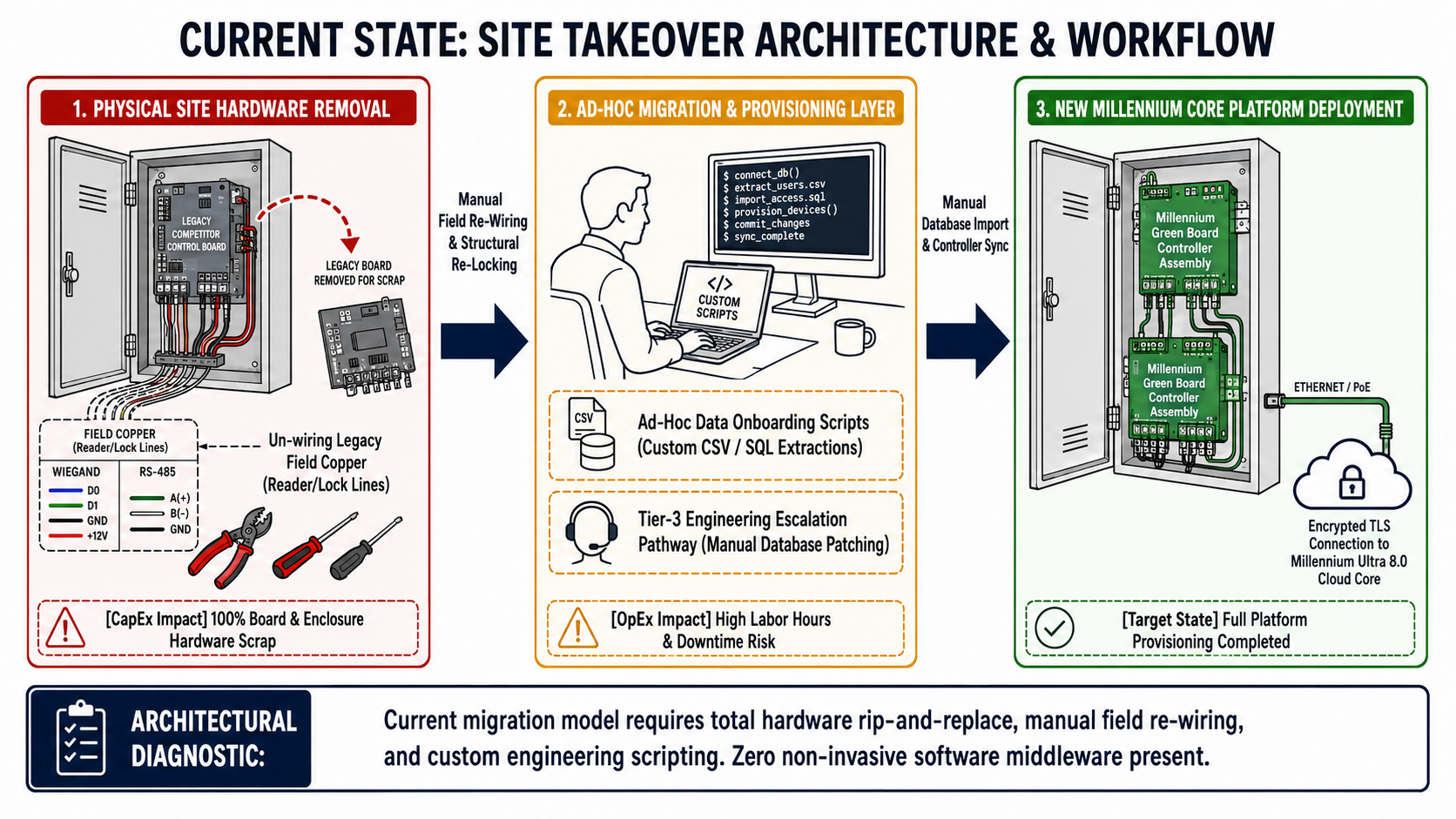
Current state: site takeover architecture and workflow

Current State

Dimensional Readiness

A structured view of established capability and current friction across each assessment dimension — the basis for prioritizing investment and measuring progress on this goal.

2.5 Composite · out of 5
2.5 D1 Platform & Tech
2.5 D2 Ecosystem & Channel
2.5 D3 Integration
2.2 D4 Ops Automation
2.8 D5 Governance
D1

Platform & Technical Foundation

2.5
Established Today

Capabilities anchoring this score

4 Strengths

Full Site Migration & System Replacement

Proven ability to execute complete, end-to-end site migrations via full system rip-and-replace, taking over legacy environments at the root level.

Extensible Event Logging Infrastructure

Robust event logging framework capable of ingesting, processing, and storing high-volume continuous data streams without throughput degradation.

Edge Resilience & Core Uptime

High-availability architecture at the local controller/edge level, ensuring continuous operation and data buffering even during network disruptions or system cutovers.

Scalable Data Ingestion & API Layer

Well-structured core platform API capable of managing scale across user databases, access rules, and device event streams.

Where to Focus

Priority areas to advance readiness

2 Priorities

Lacks Non-Invasive Middleware

Absence of a standardized, non-invasive integration engine capable of hooking directly into heavily gated or closed competitor environments without requiring hardware changes.

Dependence on Full System Replacements

Architecture currently relies on total hardware and system rip-and-replace projects rather than leveraging decoupled automated interface agents to transition sites dynamically.

D2

Ecosystem & Channel Readiness

2.5
Established Today

Capabilities anchoring this score

2 Strengths

Overwhelming Dealer & End-User Demand

Strong, active market pull for competitive takeover solutions—specifically from customers looking to escape expensive hardware rip-and-replace costs.

Targeted Value Positioning

Clear core message focused on rescuing clients trapped in high, recurring competitor licensing models and rigid vendor ecosystems.

Where to Focus

Priority areas to advance readiness

4 Priorities

Partner Network Activation

Channel partners currently lack active engagement, enablement, and incentivization to proactively push migration and takeover programs to their local accounts.

Quantifiable ROI & Economic Models

Need to build clear, validated ROI models that tangibly demonstrate capital and operational savings to convince risk-averse decision-makers.

Self-Service Channel Enablement

Lack of standardized, self-service software toolkits and diagnostic assets for partners to execute site transitions independently.

Field Escalation Reliance

Cutover processes depend heavily on direct Tier-3 engineering escalations and custom manual interventions rather than streamlined field workflows.

D3

Integration & Interoperability

2.5
Established Today

Capabilities anchoring this score

4 Strengths

Production-Ready Core API Foundation

A mature, well-structured RESTful API layer and webhooks architecture that serves as a dependable baseline for ingesting external data and connecting modern enterprise platforms.

Legacy Hardware Log Ingestion

Field-proven capability to connect with and ingest event logs directly from legacy hardware infrastructure (such as traditional Mercury controller boards) to maintain operational visibility.

Architectural Blueprinting & Design Readiness

Fully mapped conceptual frameworks and architectural models established for protocol translation, log listening, and interface automation, providing a clear blueprint for deployment.

Standardized Data Schema Mapping

Defined data normalization models that allow incoming legacy system event streams to be translated smoothly into unified platform events.

Where to Focus

Priority areas to advance readiness

3 Priorities

Blueprint Execution to Live Production

Transition conceptual blueprints for protocol translation and interface automation from theoretical design discussions into fully operational, production-ready code.

Overcoming Incumbent Vendor Ecosystem Lock-In

Major competitive cloud incumbents aggressively protect their market share by locking native APIs behind prohibitive financial paywalls, restricting direct database queries, or altering access permissions, requiring specialized workaround strategies.

Validating Production-Grade Bidirectional Control

While passive event reading is proven, real-time bidirectional command execution—such as remotely triggering critical door lock/unlock commands through a third-party legacy interface—must be fully tested, validated, and hardened in live production environments.

D4

Operational & Process Automation

2.2
Established Today

Capabilities anchoring this score

4 Strengths

Standardized Operational Frameworks

Fully structured, step-by-step administrative procedures in place to ensure consistency, clarity, and compliance across daily system management.

Turnkey Administrative Governance

Enterprise-grade policy enforcement models designed to streamline operator onboarding, permission mapping, and role-based access delegation.

Continuity-First Process Design

Operational workflows crafted specifically to eliminate risk and avoid facility downtime during site updates, system reconfiguration, or organizational changes.

Unified Centralized Oversight

Single-pane operational visibility allowing security personnel and administrators to easily monitor, audit, and manage overall facility activity.

Where to Focus

Priority areas to advance readiness

2 Priorities

Productized Migration Tooling

Site takeover and data onboarding workflows still rely heavily on custom, ad-hoc scripting rather than fully automated, productized middleware engines.

Automated Interface Execution

Lack of automated UI-driven action translation tools to trigger and execute commands directly on locked or gated competitor portals.

D5

Enterprise Governance & Business Systems

2.8
Established Today

Capabilities anchoring this score

4 Strengths

Uncompromising Compliance & Forensics

Enterprise-grade, immutable audit logging capabilities embedded within Millennium Ultra 8.0, offering granular traceability and accountability across every system event and administrative action.

Rigorous Regulatory Alignment

A mature security posture built to satisfy strict industry compliance standards, data privacy mandates, and corporate governance requirements effortlessly.

Institutional Risk & System Assurance

Comprehensive, continuous system tracking protocols designed to maintain data integrity, eliminate operational vulnerabilities, and protect mission-critical access environments.

Enterprise Administrative Control

Sophisticated role-based access controls and policy enforcement mechanisms that empower organizations to govern global site operations with absolute confidence and precision.

Where to Focus

Priority areas to advance readiness

3 Priorities

Flexible & Migration-Friendly Commercial Models

Evolve contract structures to offer flexible, transitional licensing frameworks that eliminate double-billing and financial overlap during phased site rollouts.

Resilient Middleware Architecture

Address the inherent vulnerability of custom middleware connections to prevent integration failures whenever third-party vendors deploy unsolicited front-end UI updates.

Automated Zero-Downtime Fallbacks

Implement automated failover and fallback protocols to guarantee continuous operational uptime and message delivery during cloud-to-cloud command execution.

Priority Focus Areas

Strategic Imperatives

Three priority moves to turn architectural takeover credibility into a repeatable, partner-led competitive conversion motion.

Integration & Migration

Productize the Site Takeover Model

Package the non-invasive bridge approach as a repeatable channel offering with documented conversion steps, reference outcomes, and clear economic advantage over traditional rip-and-replace.

Moves the model from engineering proof to a sellable integrator playbook.

Ecosystem & Channel

Activate the Partner Migration Motion

Equip dealers with demonstration assets, ROI models, and field toolkits so competitive takeovers become a proactive sales motion rather than a custom engineering engagement.

Channel activation is the multiplier for scaling beyond direct enterprise pursuits.

Platform & Tech

Validate Production-Grade Field Control

Harden bidirectional door control, offline continuity, and life-safety compliance in live customer environments so the takeover model meets enterprise reliability expectations.

Field proof closes the credibility gap that currently limits broader rollout.

Recommended Pilot · 12 weeks

Competitive Site Takeover Pilot

This pilot validates a non-invasive path to winning competitor accounts. Instead of replacing control boards and rewiring every door, Millennium adds a small on-site bridge to existing competitor hardware and moves access decisions to the Millennium cloud. The goal is to confirm speed, reliability, and commercial viability, so sales and channel partners can offer site conversion as a lower-cost, lower-risk alternative to traditional rip-and-replace.

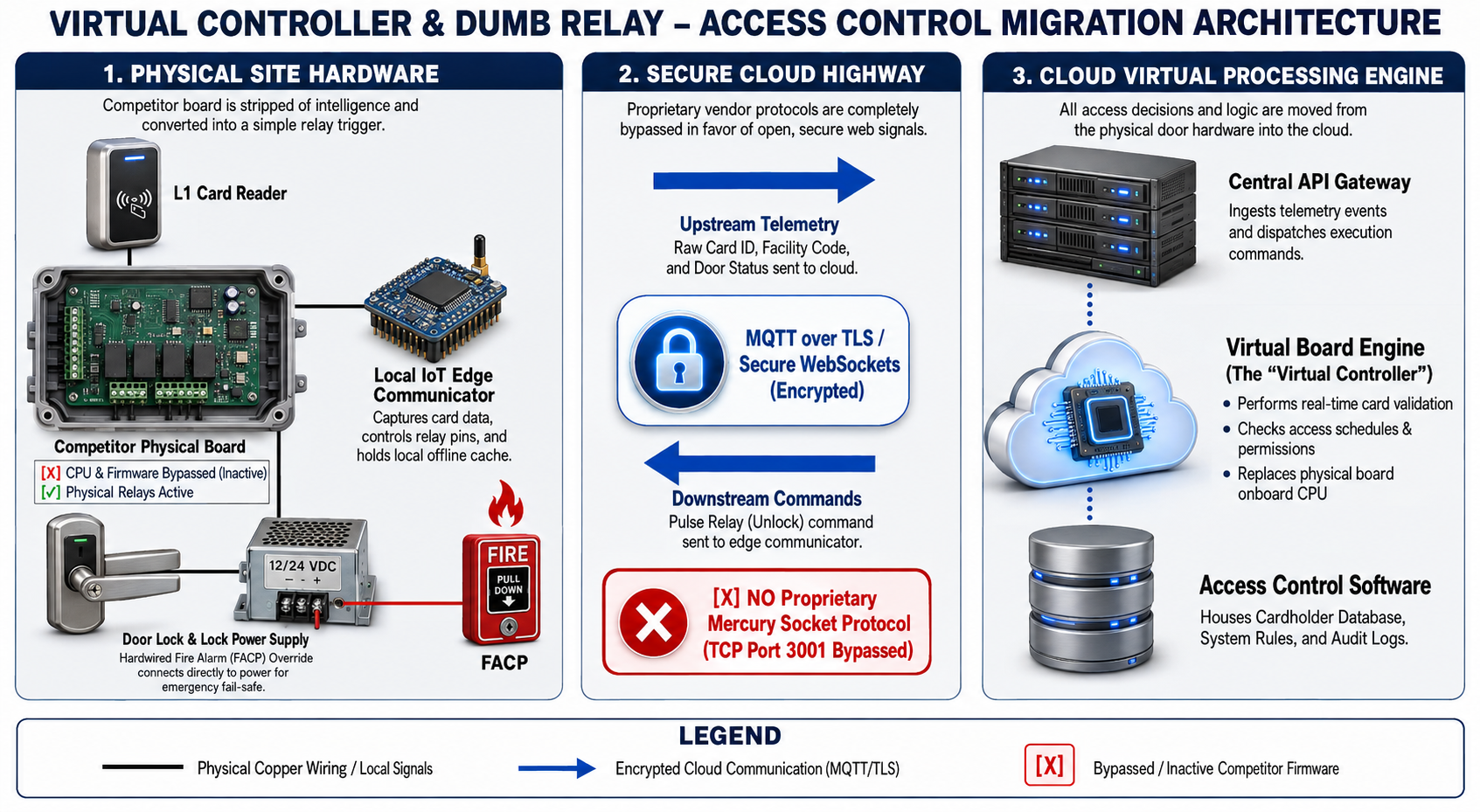
Diagram showing how existing site hardware connects to Millennium cloud for competitive site takeover
Competitive Takeover Model, Keep Hardware, Replace the Platform

Success Criteria

Commercial viability confirmed with fast, reliable door control at pilot scale

Existing competitor hardware retained, no board replacement required

Customer-safe operation verified, including offline continuity and life-safety compliance

How It Works

Business Case & Execution Plan

01

How the Takeover Model Works

Millennium separates who owns the customer relationship and access rules from what hardware is already installed on site. Competitor boards stay in place; Millennium becomes the operating platform.

On-Site Hardware
Existing Competitor Hardware (Kept In Place)

The customer’s installed control boards from Mercury, Brivo, Verkada, and similar vendors remain mounted and wired. Millennium does not require a hardware swap, only a change in who controls access decisions.

Local Bridge
On-Site Bridge Device

A compact Millennium device attaches to the existing installation and translates site activity into Millennium-managed events. It enables door control without reopening walls, rewiring readers, or replacing boards.

Local Continuity Backup

If internet service is interrupted, recent authorized access continues to work locally so customers do not experience operational disruption during conversion or day-to-day use.

Millennium Cloud
Millennium Cloud Decision Engine

All access decisions, who may enter, when, and where, are enforced in Millennium’s cloud platform in real time, replacing dependence on the competitor’s locked software stack.

Enterprise Control Platform

Cardholder records, schedules, permissions, audit history, and operational reporting live in Millennium’s core platform, the system integrators and end customers actually manage day to day.

02

Winning Sites Without Rip-and-Replace

The on-site bridge passively monitors voltage on existing reader and door circuits, capturing activity without disrupting the site. Events are sent over a secure cloud link to Millennium; approved unlock commands return the same path to trigger the board’s relay.

Site-Level Integration · No Vendor API Required
1
Site Inputs

Capture at the door

Card Reads at the Reader
5V Wiegand / OSDP pulses

Each swipe produces voltage pulses on the reader lines. The bridge taps those signals passively, reads the credential, and sends the event to Millennium cloud for approval.

Door Position Status
Voltage state change

Open and closed door states show up as voltage shifts on the position inputs. The bridge captures those changes and reports them to cloud alongside card activity.

2
Unlock Output

Command back to the door

Relay Trigger on Existing Board
3.3V relay pulse

When Millennium approves access, the cloud sends an unlock command to the bridge. The bridge outputs a short voltage pulse to the board’s relay driver, energizing the lock circuit already on site.

Site to Cloud and Back
  1. Voltage captured

    Bridge detects reader pulses or door state changes on existing wiring

  2. Sent to cloud

    Event transmitted over encrypted link; Millennium validates credential and rules

  3. Relay pulsed

    Approved command returns to the bridge, which triggers the onboard relay to release the lock

Why It Works Across Competitors

Because the model relies on how doors and controllers already behave in the field, not on competitor software cooperation, it can be repeated across manufacturers and account types.

Industry-Standard Reader Behavior

Credential readers across major manufacturers produce the same practical site events Millennium needs to manage access.

Existing Lock and Relay Infrastructure

Doors already depend on physical relays and power circuits that Millennium can command without replacing the control board.

No Incumbent Software Dependency

Sales teams do not need competitor API access, admin credentials, or migration cooperation from the losing vendor to convert a site.

Repeatable Conversion Playbook

The same takeover motion can be packaged for integrators as a faster, lower-cost alternative to traditional replacement projects.

03

Edge-to-Cloud Communication Framework

The on-site bridge maintains a persistent, bi-directional link to Millennium cloud over encrypted MQTT (TLS 1.3), so card events and unlock commands move in milliseconds without heavy REST polling or opening inbound ports at the customer site.

Local Bridge MQTT / TLS 1.3 Cloud Broker Access Engine
1
Secure, Always-On Connection
  • MQTT over TLS 1.3

    Traffic uses MQTT v5 on port 8883 (or secure WebSockets on 443), a lightweight, always-open channel suited to real-time door control.

  • Mutual device authentication

    Each bridge presents a unique x.509 device certificate (stored in a secure hardware element) so only trusted devices can connect.

  • Built for low latency

    Small MQTT packet headers and a persistent socket avoid the delay of repeated HTTP polling, critical for sub-second unlock response.

  • Outbound only

    The bridge initiates all connections to the cloud; no inbound HTTP, SSH, or other ports are exposed on the local customer network.

2
What Travels Between Site and Cloud
  • Site → Cloud

    Structured event messages for card swipes, door status, and timestamps, enough for Millennium to apply customer access rules.

    Example, Card swipe: Reader 01 · Card ID 89210 · Facility 104 · 26-bit format · timestamp logged

  • Cloud → Site

    Unlock commands specifying which relay to pulse and how long to hold, translated by the bridge into the voltage pulse on existing hardware.

    Example, Unlock command: Relay 1 · hold 5 seconds · reason: Access granted

3
Reliability When the Network Falters
  • Guaranteed delivery (QoS 1)

    Critical card events and unlock commands use MQTT QoS 1 with acknowledgment (PUBACK) so messages are not lost during brief network jitter.

  • Keep-alive & offline detection

    The bridge sends periodic ping heartbeats (~15 s) to keep firewalls open. An MQTT Last Will message triggers an automatic DEVICE_OFFLINE alert if the link drops unexpectedly.

4
When Internet Goes Down
  • Local authorization fallback

    A local flash cache stores the last 1,000–5,000 active credential hashes synced from cloud, approved users can still enter without waiting for cloud approval.

  • Store-and-forward queue

    Events generated during an outage are written to a persistent local buffer and automatically uploaded in a burst when the TLS connection is restored.

Future Vision

A concise read on today’s friction and tomorrow’s upside — then five pilots ranked by strategic importance, sequenced across 30 weeks with pilot-scoped success KPIs.

Assessment Synthesis

From solid foundation to scaled advantage

Millennium averages 3.4 / 5 across three technical strategic goals — production-proven, with meaningful upside if these five pilots convert capability gaps into repeatable motions within a focused 30-week program.

Current State

Where friction remains today

  • Competitive wins still depend on rip-and-replace or custom engineering
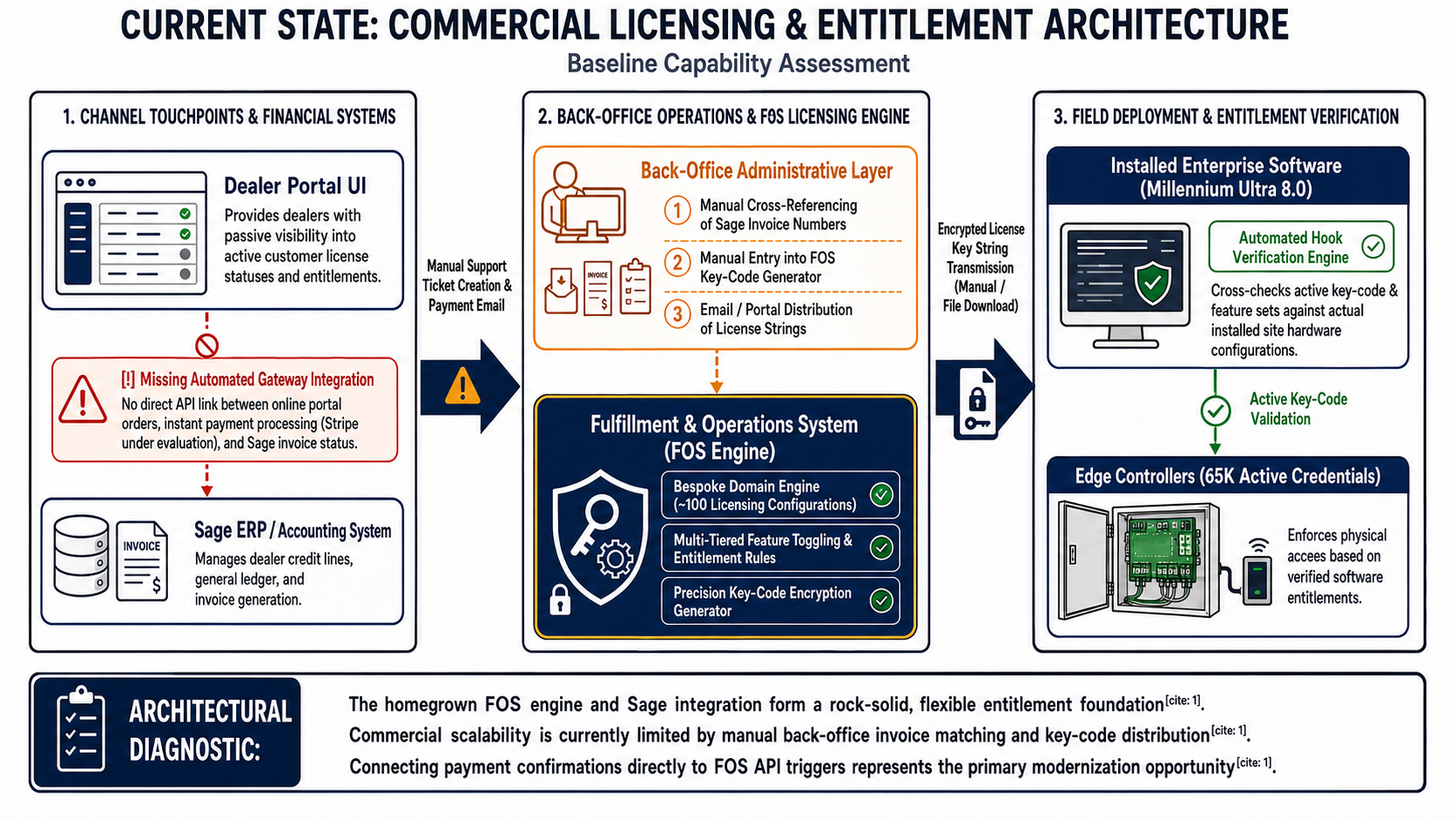
  • License sales and renewals require back-office manual processing
  • Dealers wait on support tickets for routine relicensing and key-codes
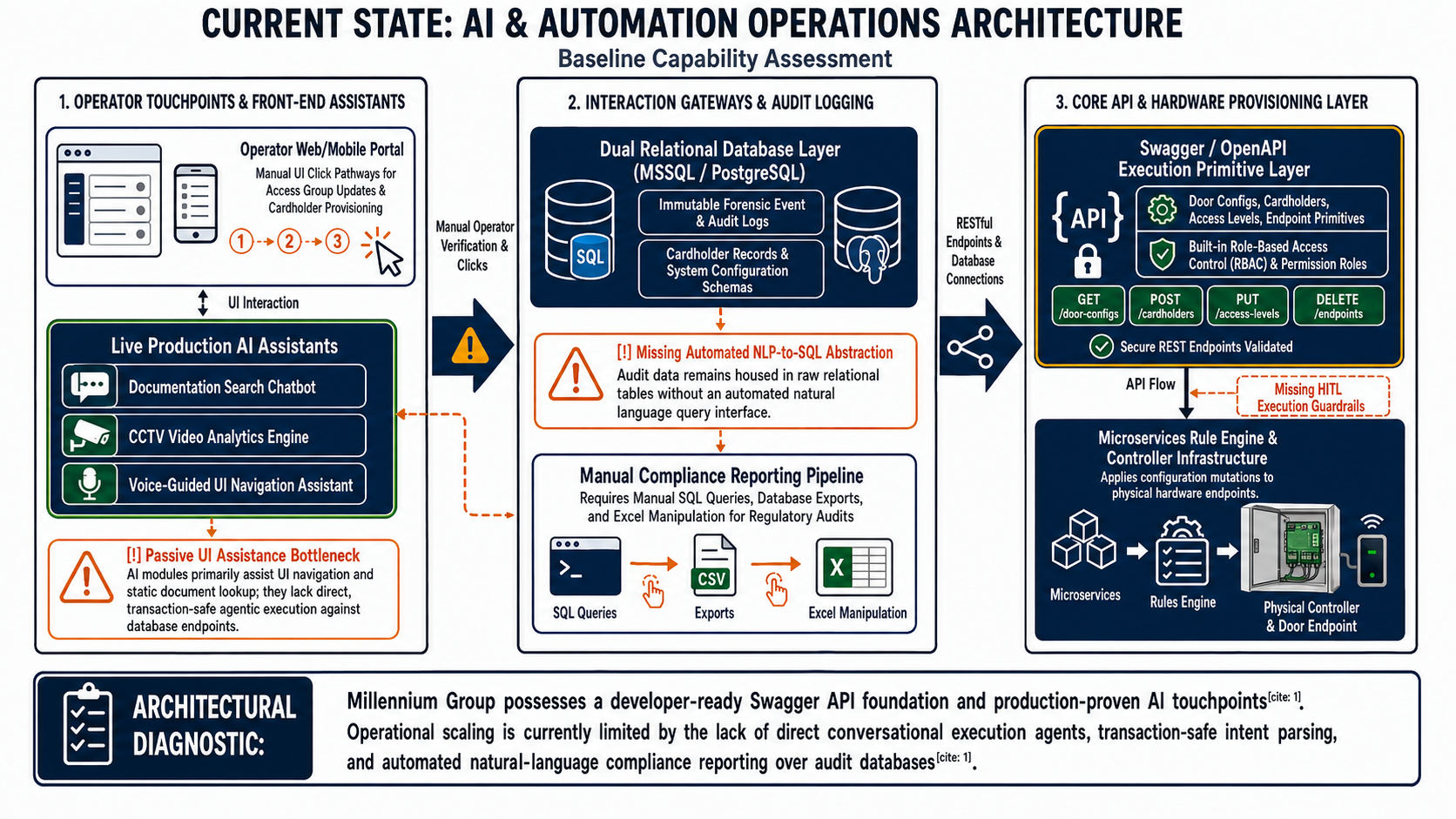
  • Daily door and credential admin flows through multi-step portal screens
  • Compliance reporting relies on manual SQL exports and spreadsheets
Collective Impact

What changes when these pilots land

  • Convert competitor-installed sites without replacing hardware
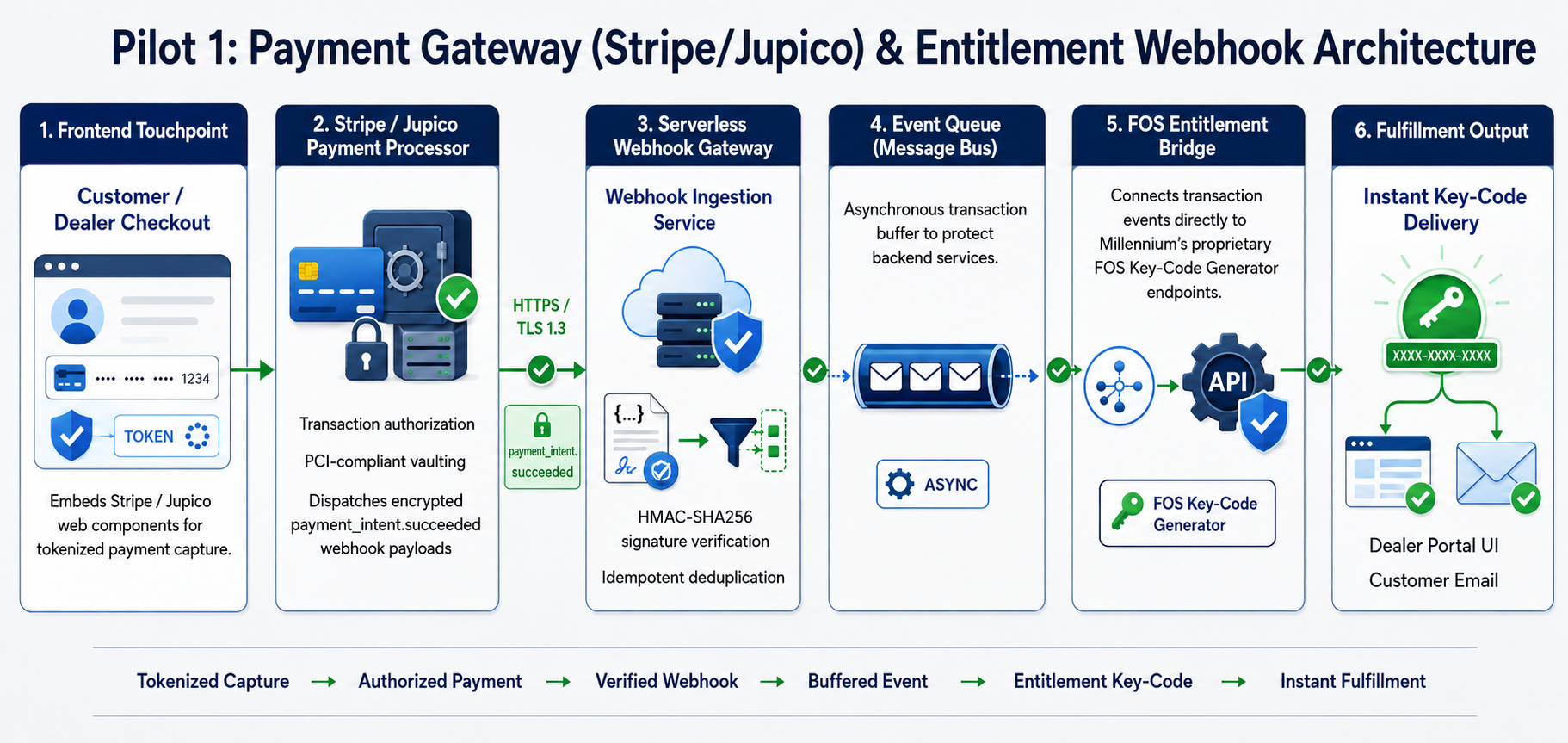
  • Deliver license keys within seconds of secure digital payment
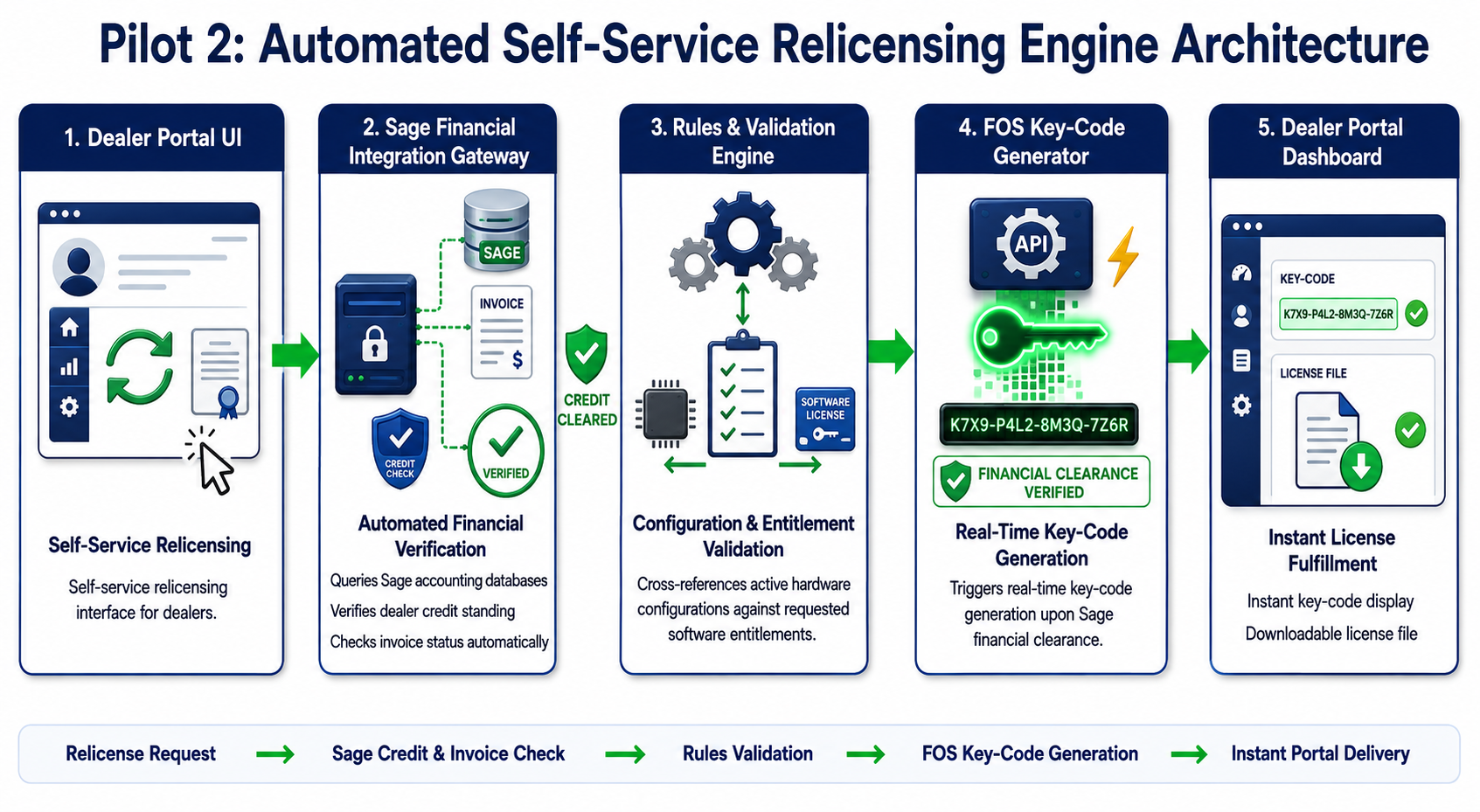
  • Let channel partners self-serve relicensing verified against Sage
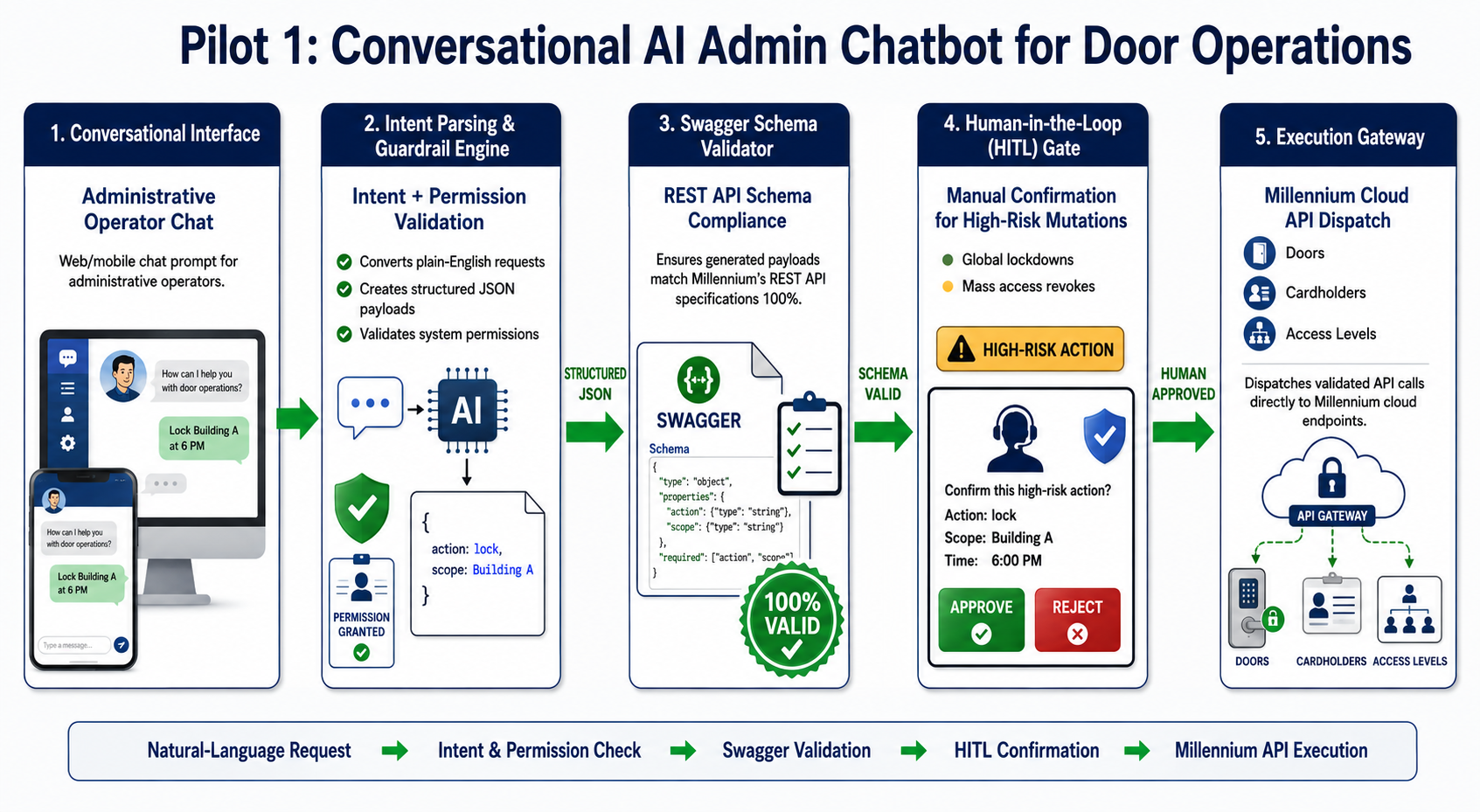
  • Handle routine access changes through governed conversational admin
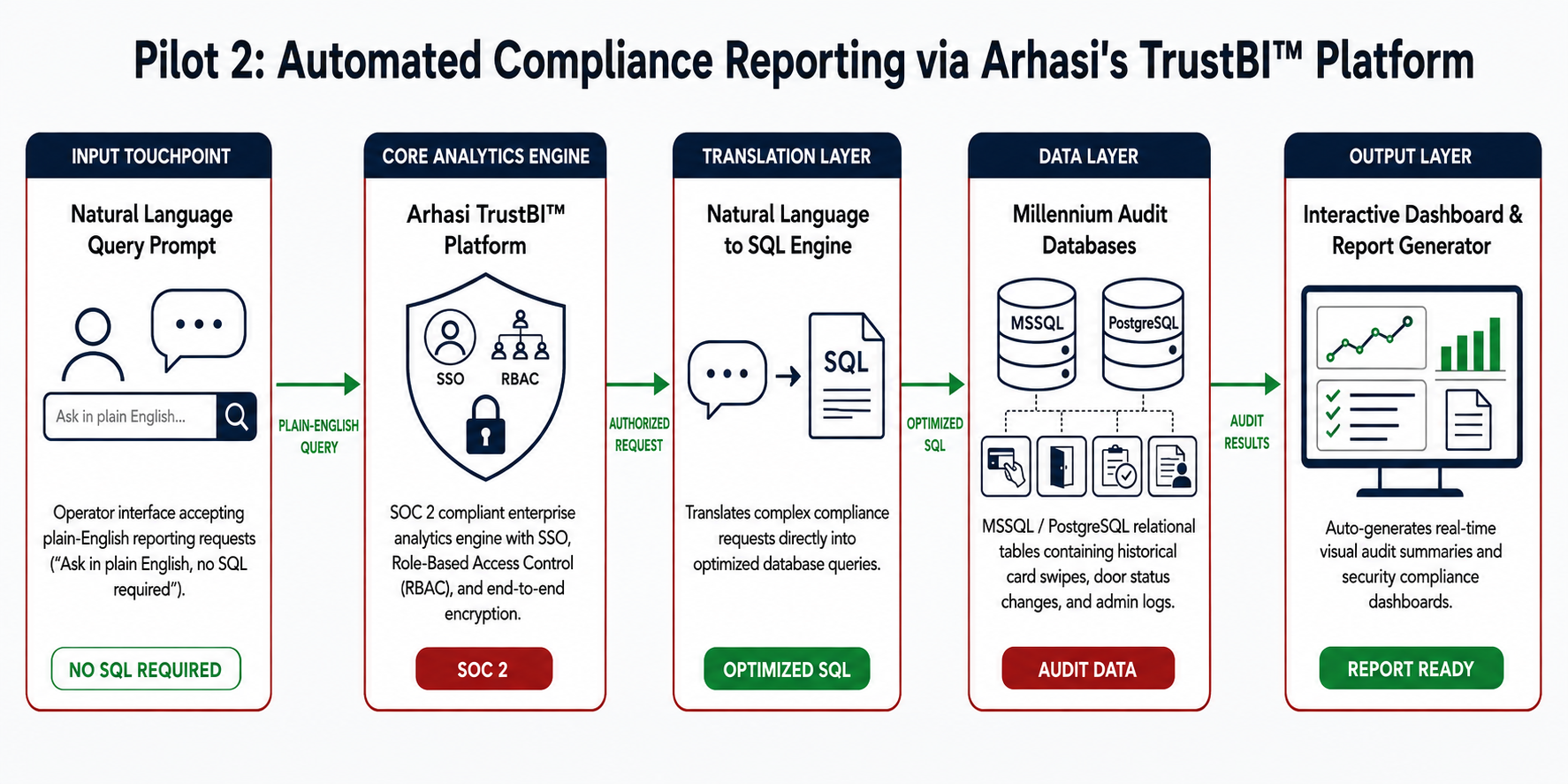
  • Produce audit-ready compliance dashboards through TrustBI™
Pilot Portfolio

Implementation path by priority

Strategic Goal 01 · Accelerate Integration & Migration 12 weeks

Competitive Site Takeover Pilot

This pilot validates a non-invasive path to winning competitor accounts. Instead of replacing control boards and rewiring every door, Millennium adds a small on-site bridge to existing competitor hardware and moves access decisions to the Millennium cloud. The goal is to confirm speed, reliability, and commercial viability, so sales and channel partners can offer site conversion as a lower-cost, lower-risk alternative to traditional rip-and-replace.

5.0 Importance · out of 5
Implementation Plan

12-Week Pilot Plan

  1. 1 Weeks 1–3
    Prove the On-Site Model

    Validate that Millennium can read card activity and control doors through existing competitor boards at Millennium and reference competitor sites. Confirm life-safety requirements remain intact and that the approach works without vendor cooperation or site downtime.

  2. 2 Weeks 4–9
    Connect Site to Millennium Cloud

    Stand up the cloud decision engine, secure site-to-cloud communication, and local backup behavior so doors keep working during network interruptions. Prove that access rules, permissions, and unlock commands run through Millennium, not the incumbent platform — including extended field testing across hardware variants.

  3. 3 Weeks 10–12
    Live Customer Proof Point

    Run a controlled pilot at a designated client site (e.g., St. Barnabas target doors). Measure conversion speed, door response time, operational reliability under load, and readiness to package the playbook for channel partners.

Target State

What Success Looks Like

If the pilot succeeds, Millennium productizes this takeover capability into a repeatable conversion offering for integrators and enterprise accounts. That positions Millennium not only as an access control vendor, but as the platform that can migrate competitor-installed estates at materially lower cost, with shorter sales cycles and stronger channel differentiation.

Measurable at pilot close
Pilot doors under cloud control ≥2 doors at reference site with sub-2s median unlock response
Hardware retained Zero board replacements required at pilot site
Offline continuity Successful access during simulated network outage at pilot doors
Field playbook validation Integrator sign-off on documented conversion steps from pilot walkthrough