Strategic Operations Assessment · August 2026

Millennium Group Inc. · Go-to-Market & Commercial Operations

Strategic Operations
GTM Assessment Report

A commercial assessment of where Millennium Group stands today across demand generation, dealer channel activation, and competitive market access — acknowledging proven go-to-market strengths and naming the highest-leverage commercial paths.

3 Go-to-Market Objectives
5 Lead-to-Cash Stages
7 Competitors Assessed

The three go-to-market objectives

Each objective answers a different question and owns a distinct body of evidence. Click a card to reveal its boundary.

The three do not overlap, and a fact belongs to exactly one of them.

Boundary case · GTM-02

Bundled subscription adoption sits in GTM-02, because the finding is about dealer willingness to sell it. The billing and licensing mechanics behind it remain with Goal 03, Modernize Commercial Operations.

Boundary case · GTM-03

The St. Barnabas account appears in GTM-03 as a displacement and win-back position case. Its implications for the takeover process are referenced in GTM-01 but not re-argued there.

Assessment by GTM Objective

Each go-to-market objective evaluated in three views — what is established today, where friction remains, and the assessment finding that follows from both.

GTM Objective 01

Systematize Demand Generation and Lead-to-Cash

Convert an opportunity flow that already exists into a measured, repeatable process, so that growth becomes a function of system design rather than individual effort.

What exists today

What exists today

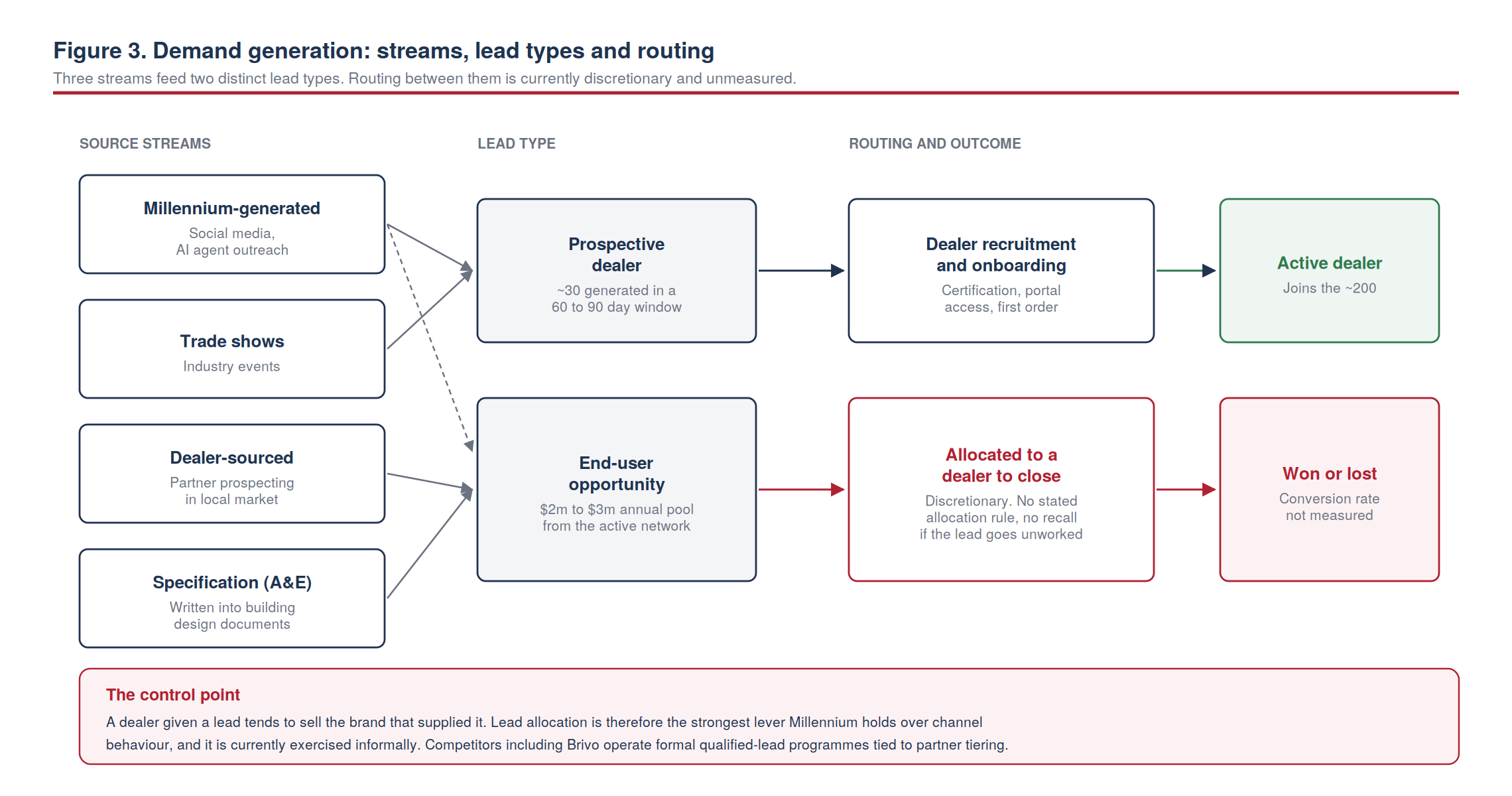
Three live lead-generation streams

operating in parallel: Millennium-generated leads through social media and AI agent outreach, trade show presence, and dealer-sourced opportunities. This is a genuinely multi-channel top of funnel, not a single-source dependency.

A working distinction between two lead types.

The commercial team already separates prospective new dealers from end-user opportunities routed to existing dealers. That distinction is the foundation of any routing logic and it is already in use.

Demonstrated outbound capability.

Roughly 30 new dealer leads were generated in the last 60 to 90 days through outreach effort. The motion works when it is run.

A quantified opportunity pool.

The active dealer network generates between $2 million and $3 million in new end-user opportunities annually.

Specification as a durable acquisition path.

Where an architect or engineering firm writes Millennium into a project specification during building design, the position is difficult for a competitor to displace once construction is underway.

CRM infrastructure with AI already applied.

Salesforce has been upgraded with Einstein, and sales calls are monitored for question quality and next-step discipline. The instrumentation layer for a measured funnel is in place.

A resilient back end of the cycle.

Retention through the cash stage is strong because installed systems are deeply embedded, and customers are reluctant to absorb the cost and disruption of replacement.
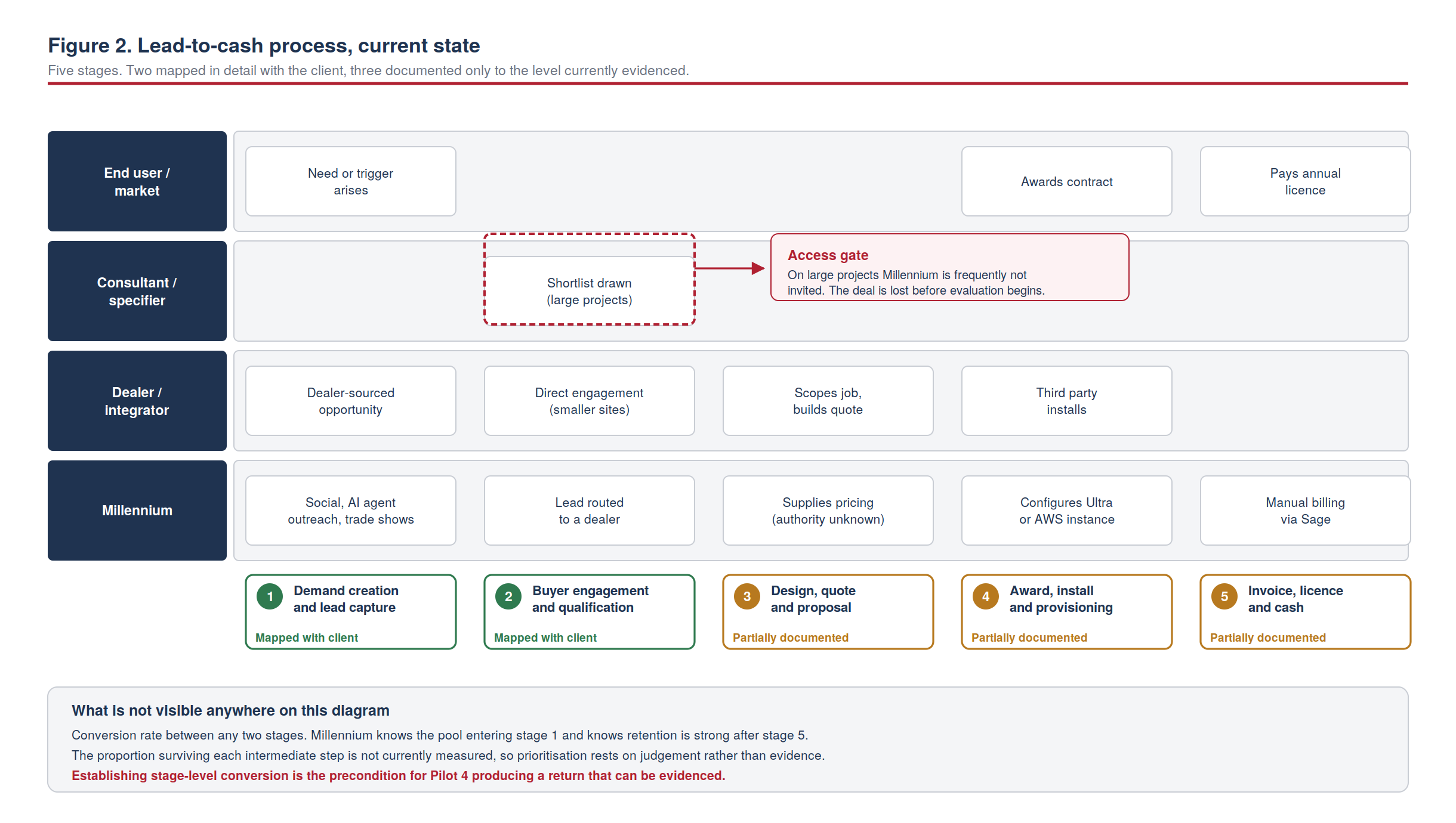
Current friction

The process is mapped for two of five stages.

Lead-to-cash has been walked end to end through the early stages only. The middle and late stages, covering quoting, award, provisioning and cash collection, have not yet been documented at the same level.

Opportunity conversion is not measured.

The $2 to $3 million annual opportunity pool is known at the top. What proportion converts, where it is lost, and how long it takes are not currently visible.

Lead allocation is discretionary.

There is no stated rule set governing which dealer receives which lead, and no follow-up mechanism to recover a lead that goes unworked. Given that the dealer who receives a lead tends to sell the brand that supplied it, this is a high-leverage control that is currently informal.

Two lead types share one pipeline.

Dealer-recruitment leads and end-user opportunities have different cycle lengths, owners and success measures, but are not tracked as distinct funnels.

Loss reasons are collected informally.

Where a competitive loss is understood, it is generally because someone made a personal enquiry after the fact rather than because the system captured it.

Manual billing at the cash stage.

The final stage of the process still depends on manual intervention, which limits both cycle time and the reliability of revenue data.

Assessment finding

01

Activity without connective tissue

Millennium is not short of demand-generation activity. Three streams operate concurrently, outbound produces measurable dealer interest, and the CRM foundation is more advanced than the industry norm for a company of this size. What is absent is the connective tissue between activity and outcome.

02

Middle-funnel measurement gap

The specific gap is measurement across the middle of the funnel. A known opportunity pool of $2 to $3 million enters the system each year and an unknown proportion emerges as revenue. Until stage-level conversion is visible, prioritisation decisions rest on judgement rather than evidence, and any automation applied to the top of the funnel will increase volume without improving yield.

03

A favourable position to build from

This is a favourable position to be in. The instrumentation exists, the lead types are already conceptually separated, and the process has been half mapped. Completing the map and instrumenting the stages is a shorter path than building a demand engine from nothing, and it is the precondition for Pilot 4 producing a return that can be evidenced.

System and process flows

Five reference diagrams mapping actors, lead-to-cash stages, demand routing, competitive attack points, and buying-path outcomes. Use the arrows to step through each figure.

The lead-to-cash process, as understood today

Five stages have been identified. Two are fully mapped. The remaining three are partially documented, with open items marked for the next session.

2/5 Stages mapped
Mapped Partial
  1. Demand creation and lead capture

    Mapped

    Three parallel streams: Millennium-generated (social, AI agent outreach), trade shows, and dealer-sourced. Leads separate into prospective dealers and end-user opportunities.

    Known today: Volume known at stream level; conversion by stream not yet measured.

  2. Buyer engagement and qualification

    Mapped

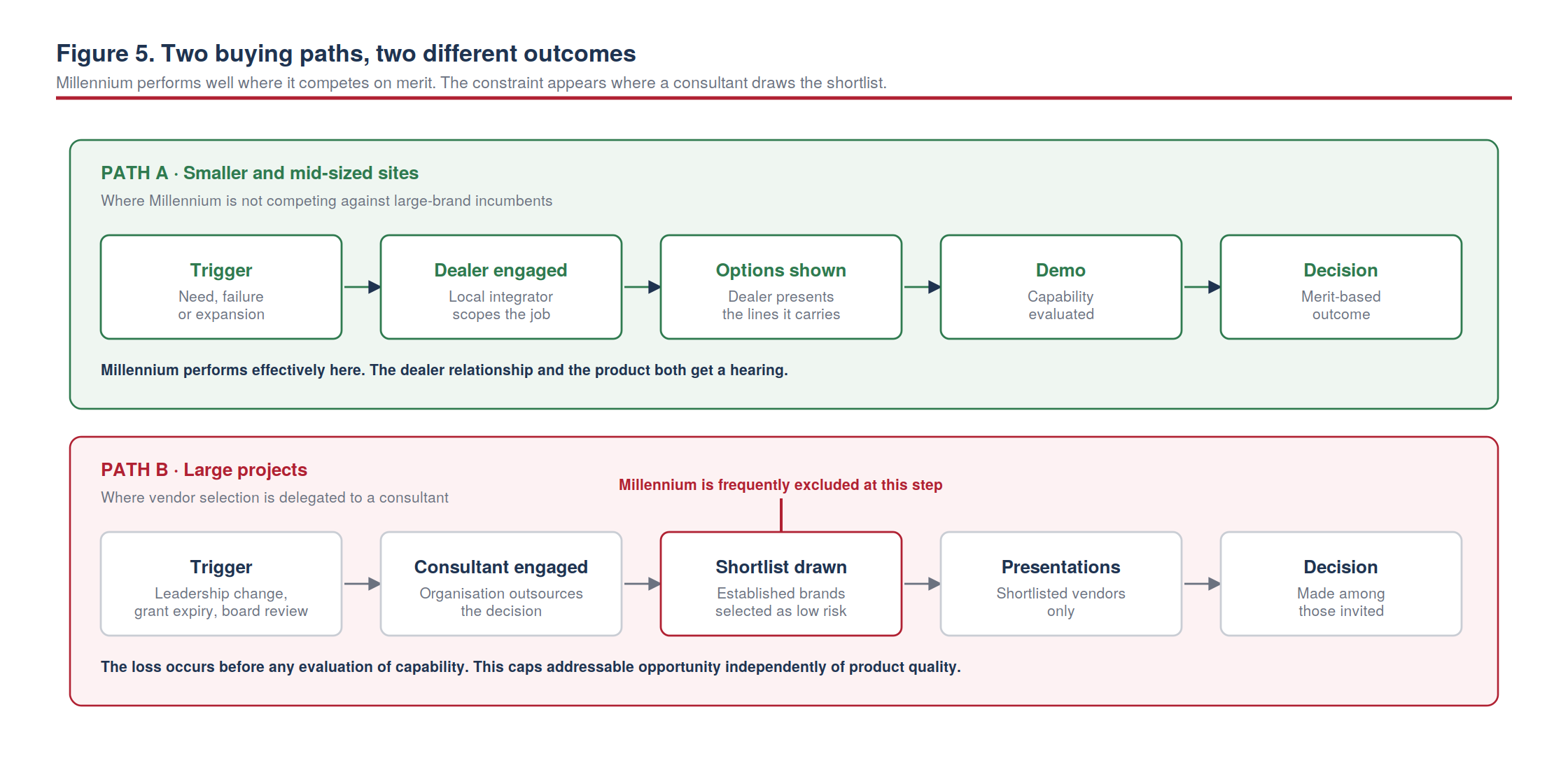
    For smaller sites, direct engagement through the dealer. For larger projects, entry is mediated by consultants and specifiers, and Millennium is frequently not invited.

    Known today: The consultant barrier is the defining feature of this stage.

  3. Design, quote and proposal

    Partial

    Dealer scopes the job. Millennium equipment forms a minority of total project value, with the balance in other equipment and labour.

    Open for next session

    Pricing authority, discount governance and proposal ownership not yet documented.

  4. Award, installation and provisioning

    Partial

    Third-party installs physical components. System configured in Ultra or the AWS-hosted environment.

    Open for next session

    Duration, handoff points and failure modes not yet documented commercially.

  5. Invoice, licensing and cash

    Partial

    Annual licensing issued from the in-house engine. Billing runs through Sage with manual intervention. Non-payment results in system suspension.

    Open for next session

    Cycle time from award to cash collected not yet established.

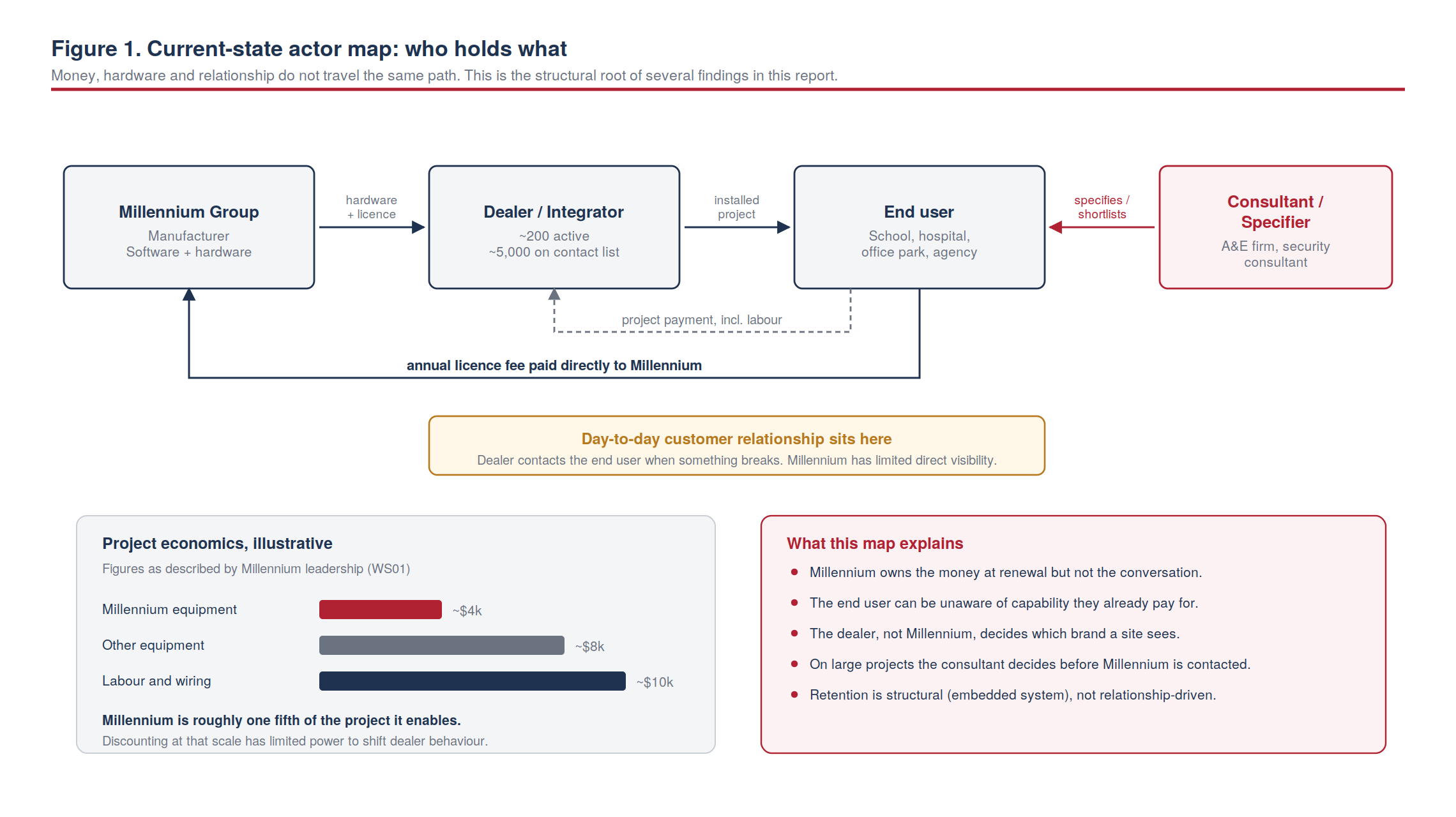
Cross-stage observation Millennium holds the commercial relationship at stage 5 through licensing and billing, while the dealer holds the customer relationship at stages 3, 4 and beyond. This split is the structural reason the end user can be unaware of capability they are entitled to, and it recurs as a root cause across all three GTM objectives.

Competitive sales motion teardown

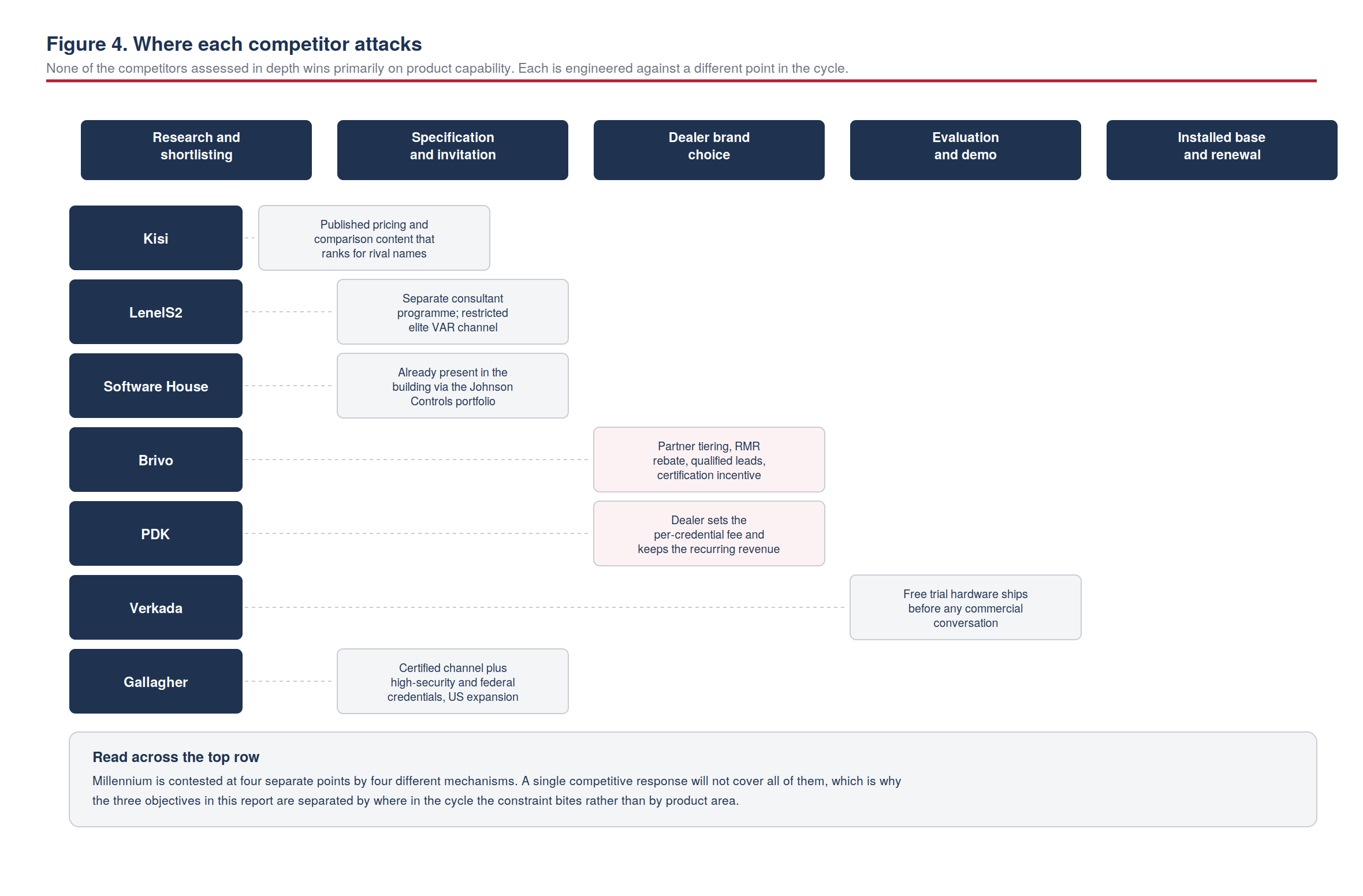
Four competitors are assessed in depth. Three are covered at summary level. Assessment focuses on how each competitor sells and reaches market, not on feature comparison.

6.5 Summary-level competitors

Three additional routes to market — each selling differently, each contesting Millennium on a distinct axis.

Gallagher Security

Certified channel + high-security credentials

  • 1,200+ certified partners Global channel with mandatory training and certification requirements.
  • Federal-grade credentials FIPS 201-3 and PIV compliance anchor US high-security positioning.
  • A&E channel entry Client-reported move into US architecture and engineering firms — warrants verification.
  • Americas expansion Dedicated Atlanta technical support signals growing US investment.

vs Millennium Emerging spec-channel competitor for the A&E path Millennium relies on.

Sources: security.gallagher.com, CB Insights, client workshop input.

Kisi

Inbound search & self-service capture

  • Self-service evaluation Low-friction online trials targeting smaller commercial sites.
  • Comparison SEO Competitor review pages rank for rival names — captures demand at research stage.
  • Content-led inbound Marketing and published comparisons drive evaluation without a channel.
  • Bid environment gap Not named in any Millennium workshop — weight carefully before over-indexing.

vs Millennium Research-stage visibility play — not yet seen in Millennium bid environments.

Sources: getkisi.com, third-party pricing analyses.

6.6 What the teardown shows

Four distinct routes to market are visible, and Millennium’s position relative to each is different.

Competitor Primary motion Where Millennium is contested
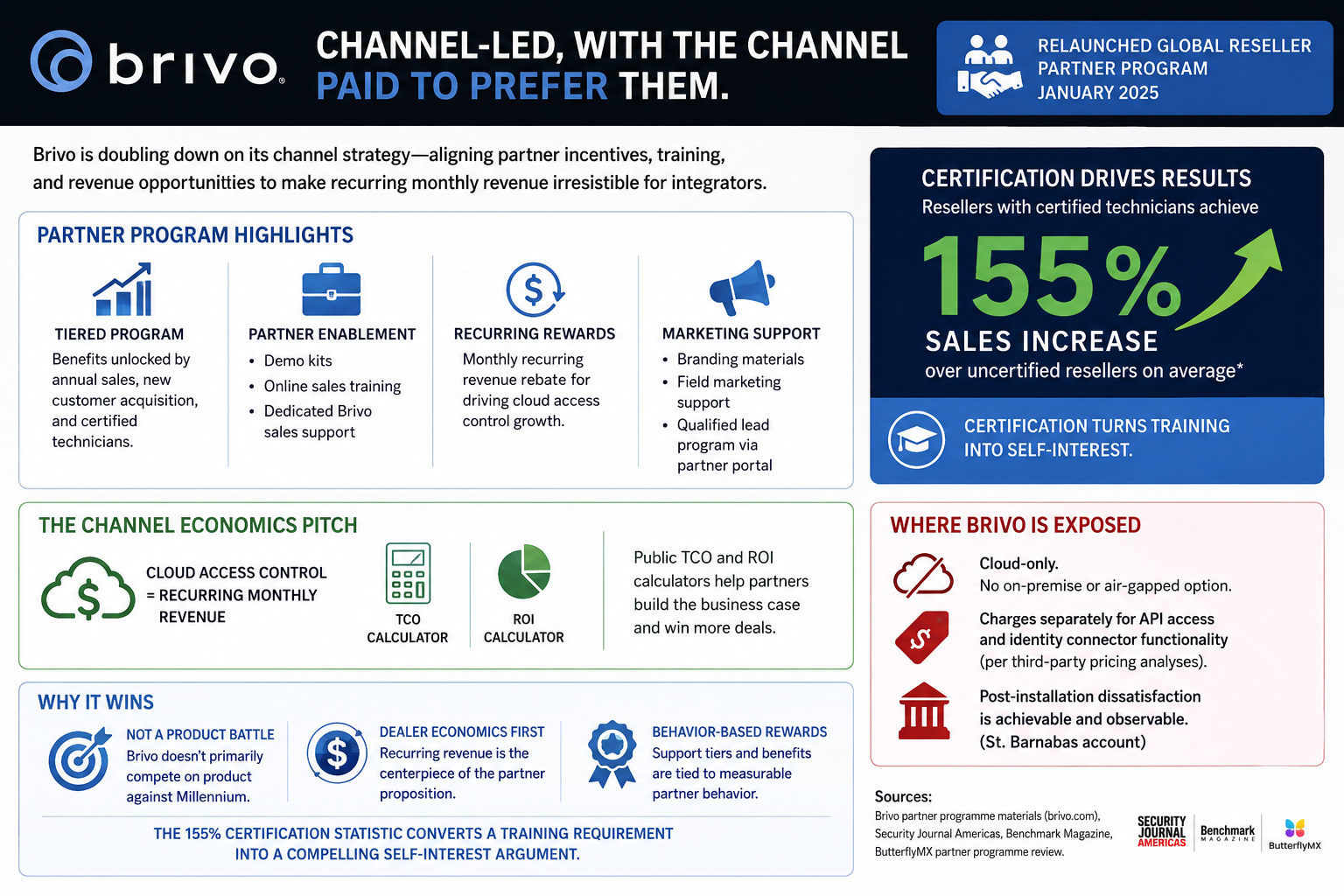
Brivo
Channel economics and partner incentive design
Dealer preference and recurring revenue argument
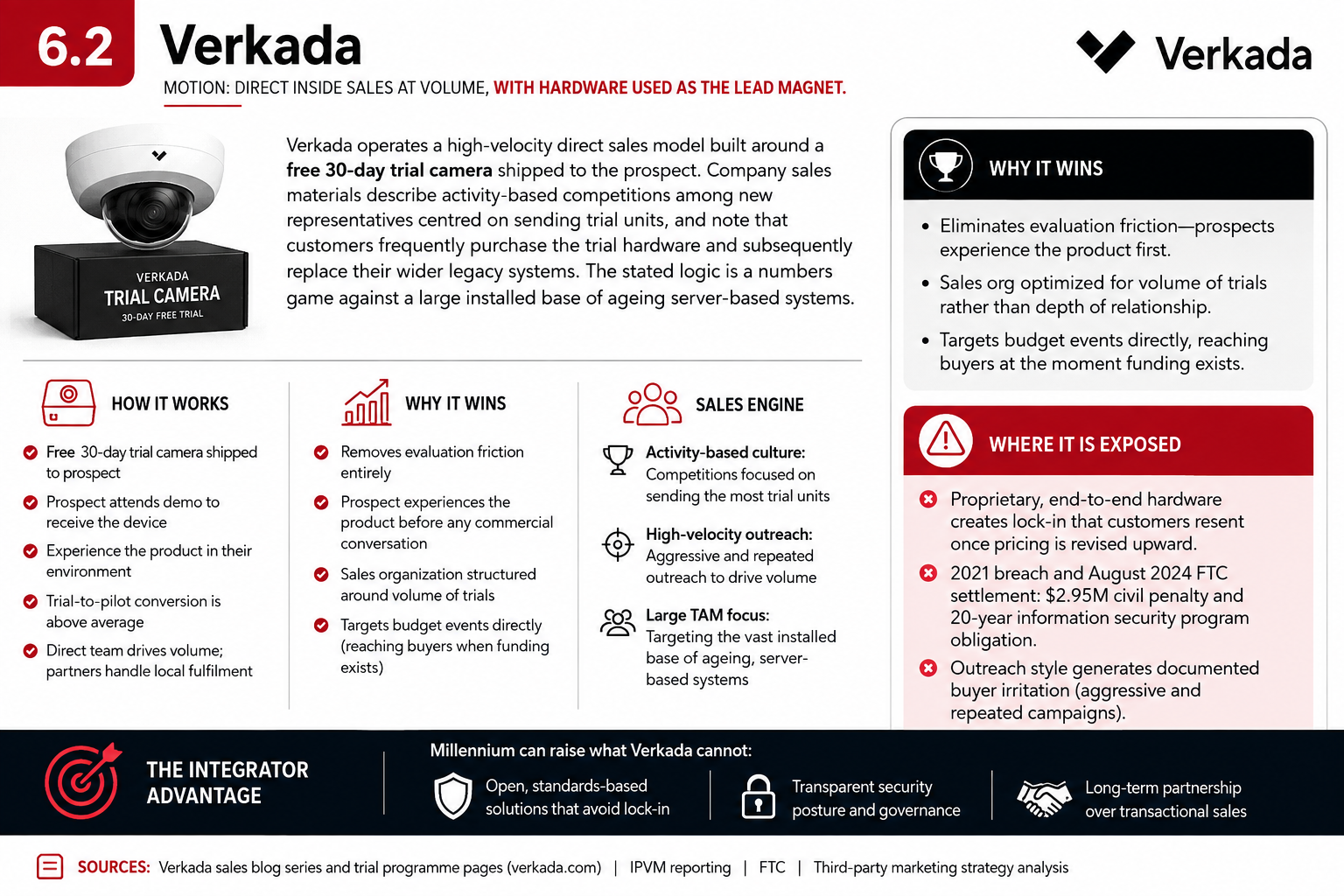
Verkada
Direct volume selling with trial hardware
End-user awareness and evaluation access
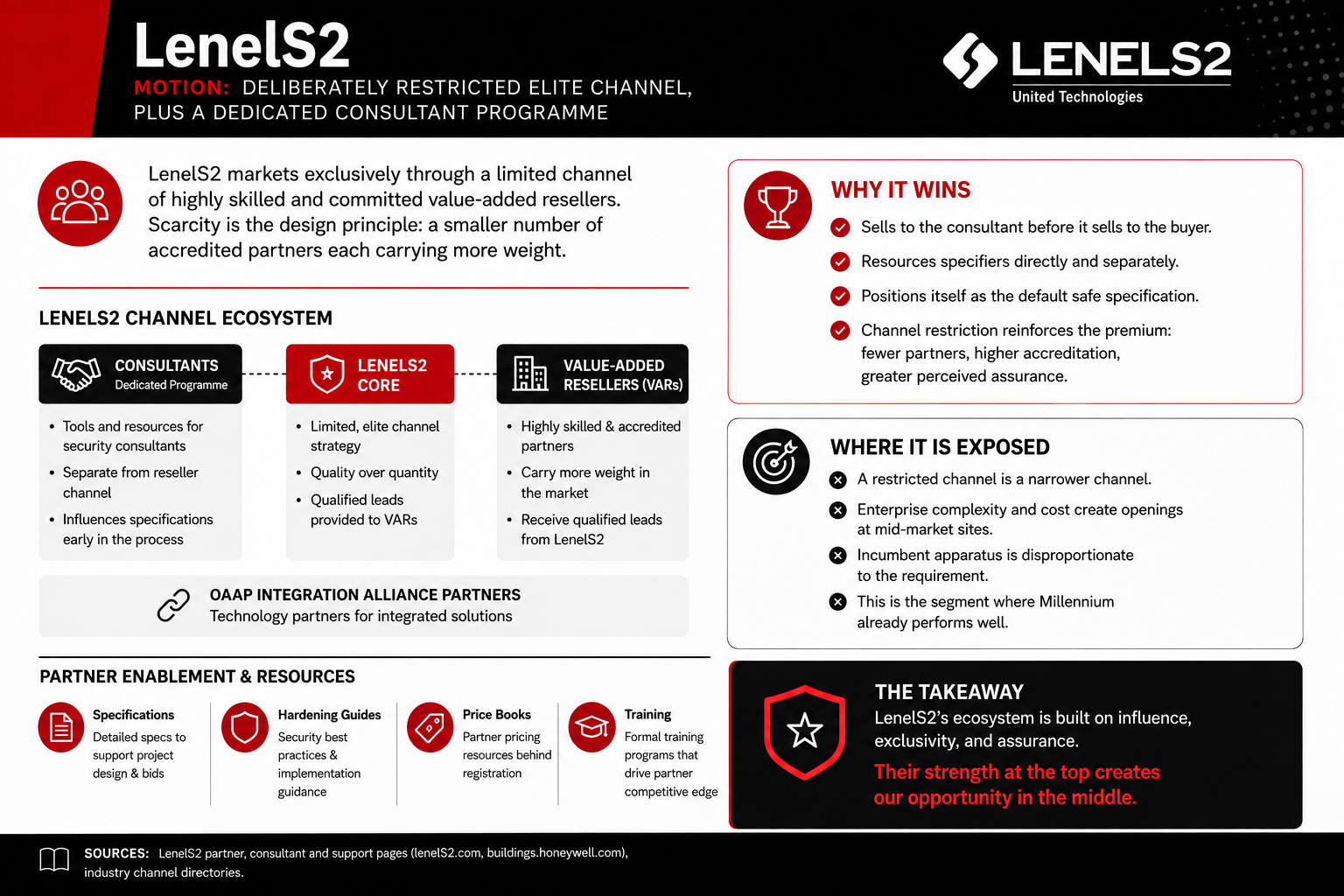
LenelS2
Consultant and specifier capture
Invitation to large projects
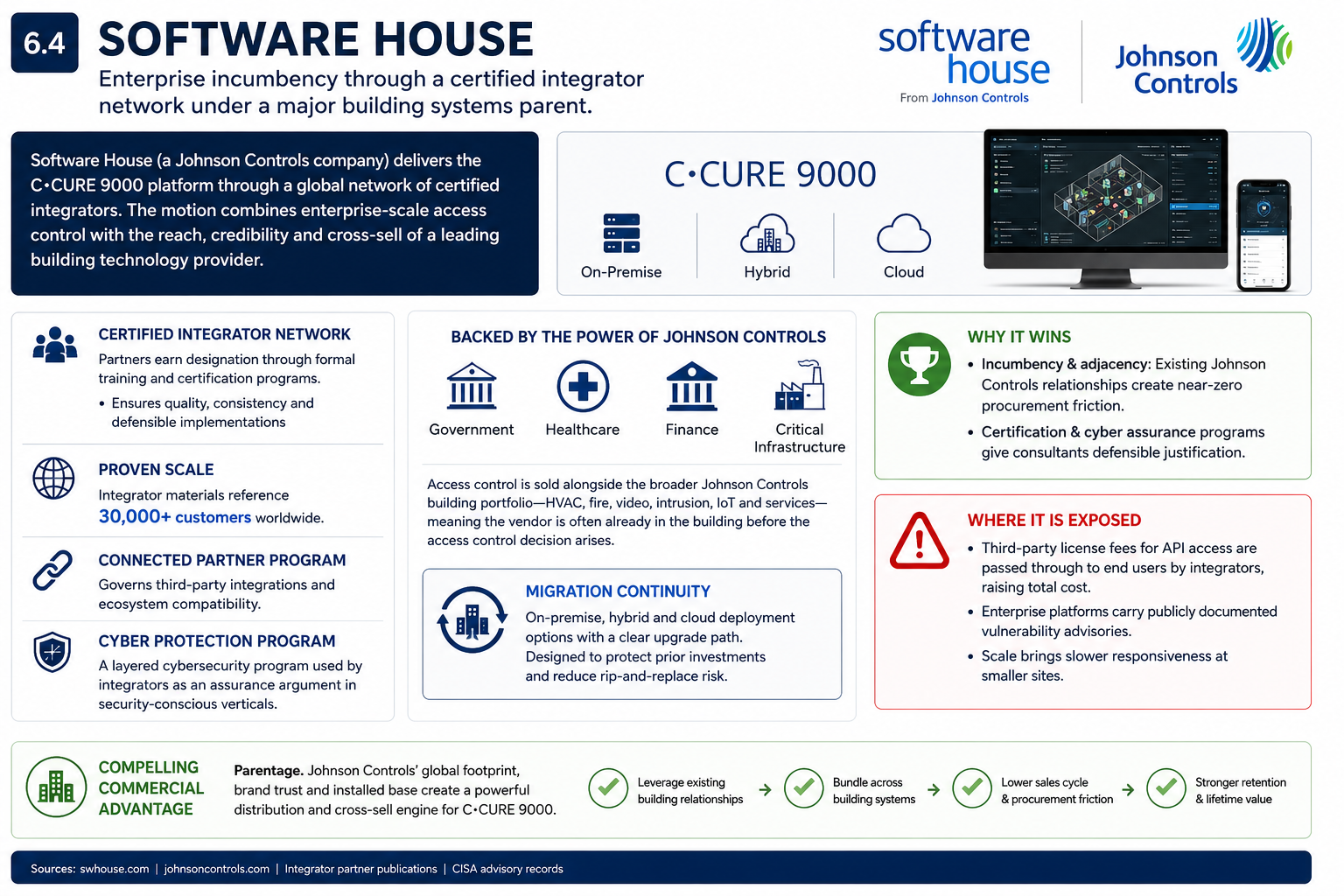
Software House
Enterprise incumbency and portfolio adjacency
Large-site credibility
PDK
Dealer-captured recurring revenue
Dealer economics at small sites
Gallagher
Certified channel plus high-security credentials
Specification channel, emerging
Kisi
Inbound and search capture
Research-stage visibility
Key takeaways

Three patterns across the competitive set

01

No competitor wins on product alone

Each wins on a route to market — not feature depth.

  • Partner economics and channel incentive design
  • Evaluation access and end-user awareness
  • Specifier and consultant relationships
  • Organisational adjacency and portfolio bundling
Implication

Millennium’s constraint is commercial, not technical — the response must match.

02

Two competitors sell to the dealer, not the customer

Integrator economics are the decision frame.

  • Brivo structures around what the integrator earns
  • PDK hands recurring revenue to the dealer outright
  • Dealers cite recurring income as valuation driver
Implication

Any Millennium channel proposition will be benchmarked against dealer-captured revenue.

03

The specification channel is becoming contested

Millennium’s stickiest acquisition path is under active investment.

  • LenelS2 resources consultants separately from resellers
  • Gallagher entering US via architecture and engineering firms
  • Spec-channel claim is client-reported — warrants verification

Metrics to baseline on the commercial side

Recommended for baselining against historical Salesforce data before any Phase 2 work begins. No target values are proposed at this stage.

Metric Why it matters Availability
Demand Opportunity conversion rate, by lead stream
Establishes which of the three demand streams produces revenue rather than activity To be confirmed
Demand Stage-level conversion across the five-stage process
Locates where the $2 to $3 million annual pool is lost Requires stage definition first
Channel Active dealer count and trend
Tracks whether the deepening strategy is producing movement above the 200 baseline Available
Channel Revenue concentration across the top 20 percent of dealers
Establishes dependency risk and measures whether concentration is easing Available
Channel New dealer leads to first transaction, and elapsed time
Tests whether recruitment produces productive partners or names on a list To be confirmed
Channel Bundled subscription attach rate, new versus legacy dealers
Measures the commercial transition directly To be confirmed
Market access Invitation rate to large-project evaluations
The single most direct measure of the consultant access barrier Not currently captured
Market access Named win/loss ratio against Brivo, Verkada, LenelS2 and Software House
Validates which competitive framing works against which route to market Requires disciplined loss capture
Cash cycle Cycle time from award to cash collected
Quantifies the cost of manual billing at stage 5 To be confirmed